Coinbase Fraud Prevention: How Did a Fine-Tuned Qwen Model Beat Opus?


Brian Armstrong Shares a Fine-Tuned Qwen Result on October 12
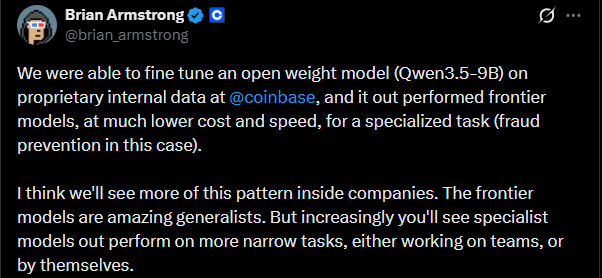
On October 12, 2026, CEO Brian Armstrong said the company fine-tuned an open-weight AI system, Qwen3.5-9B, on proprietary internal data. According to his post, it outperformed frontier systems on a specialized task at much lower cost and higher speed. That task was Coinbase fraud prevention.
The announcement adds to a steady flow of crypto news today about exchanges adopting AI. Armstrong expects more firms to build narrow specialist systems instead of relying only on general-purpose ones.
How Coinbase Fraud Prevention Works Inside Onramp
The system sits inside Onramp, which lets people buy crypto in partner apps, including guest checkout without an account. Guests have little history, so signals must come from recent transactions.
An existing machine-learning model and rules engine screen payments first. An AI agent then reviews selected transactions with recent activity as context and returns a compact risk level. It can block a payment the first layer allowed, but it cannot override an earlier block.
An earlier online test using Claude Opus showed 30% fewer fraudulent transactions and 22% less fraud value
Projected savings were roughly three times the estimated inference cost
Source: Official X Post
Qwen3.5-9B vs Opus 4.5: Benchmark Results at a Glance
The tuned Qwen system beat Opus 4.5 on all four detection metrics in the internal benchmark.
Metric | Gain vs Opus 4.5 |
Precision | +7.5 points |
Recall | +12.0 points |
F1 score | +9.6 points |
Dollar-weighted recall | +35.4 points |
Dollar-weighted recall matters most here, since it shows how much fraudulent value gets caught, not just how many cases. Values are percentage-point differences, not relative gains.
Latency and Training Cost Behind the Tuned System
Measure | Qwen3.5-9B | Opus 4.5 |
P50 latency | 0.683 seconds | 1.515 seconds |
P99 latency | 1.036 seconds | 3.312 seconds |
Median latency in live traffic fell 55% compared with Opus 4.5. Training ran on one NVIDIA RTX PRO 6000 96GB GPU for under $100, using reinforcement learning with verifiable rewards and LoRA, a method that trains a small set of added parameters. Serving used L40S GPUs, scaling between 2 and 8 replicas.
Why Owning an Open-Weight Model Changes the Economics
Armstrong argued that frontier systems are generalists, while specialists can win on narrow tasks. He also said some backend services could be replaced entirely by this architecture. For Coinbase fraud prevention, owning the weights brings several practical advantages:
Control: choose training data, checkpoints, and upgrade timing
Privacy: transaction context stays away from external APIs
Reliability: versioned weights, prompts, and decision policy
Cost: a small, tuned system can replace a pricier general one
What the Result Signals for Crypto Exchange AI
The result suggests Coinbase fraud prevention may lean more on small-tuned systems than on API-only frontier ones. Attack patterns change, so quality still depends on continued evaluation and retraining, not a single good checkpoint.
Key developments to track:
Whether the approach reaches other payment risk reviews and backend services
Fresh benchmarks, since newer frontier releases scored lower on recall and F1 in earlier internal tests
Further detail on how widely the approach will be deployed
For readers following crypto exchange news and AI in crypto, this is a concrete example of specialization beating scale on one narrow task. Coinbase fraud prevention is the one to track.
YMYL Disclaimer: This article is for informational purposes only and is not financial or investment advice. Crypto assets are highly volatile and carry risk. Please do your own research before making any decision.









